haquille O'Neal never shot a three-pointer in his first NBA season. Damian Lillard launched over 700 in his fourth. Yet the two share a trait that separates great from merely good: an almost stubborn insistence on bending the game to their will, not the other way around. O'Neal and Lillard, separated by two decades and a foot of height, built their careers on the same principle—force the defense to solve an unsolvable problem。then punish them for trying.Think about O'Neal's 2000 Finals against Indiana. The Pacers threw single coverage, double teams, even occasional triple teams at him. He averaged 38 points and 16.7 rebounds while shooting 61% from the field. That wasn't dominance through finesse. It was a physical mandate: you cannot stop me。so pick your poison. Lillard operates on a different plane but with identical psychology. His 37-foot pull-up against Paul George in 2019 wasn't just a shot—it was a statement that defensive geometry no longer mattered. O'Neal and Lillard both weaponized the idea that traditional defensive rules were suggestions, not laws.What makes the O'Neal and Lillard comparison more than a rhetorical trick is their shared ability to generate gravity. O'Neal's presence warped entire defensive schemes—help defenders cheated two steps toward the paint before he even caught the ball. Lillard's range forces opposing coaches to extend pick-and-roll coverage to half court. I watched a Portland game last season where Lillard crossed the logo and two defenders immediately stepped up, leaving a lob pass to the rim wide open. That's O'Neal-level attention, just applied 25 feet from the basket. Both players turned their individual threat into a structural advantage for teammates who suddenly had room to operate.There's a mental toughness angle here, too. O'Neal absorbed hard fouls and hack-a-Shaq tactics with a smirk and then dropped 30 anyway. Lillard has spent years hearing that small-market Portland can't win big, that his defense is a liability, that his window is closing. His response: six All-NBA selections, a 71-point game, and a perpetual chip on his shoulder. O'Neal and Lillard don't complain about the rules of engagement. They memorize them。then exploit every loophole. That's not just talent. It's professional stubbornness in its most productive form.
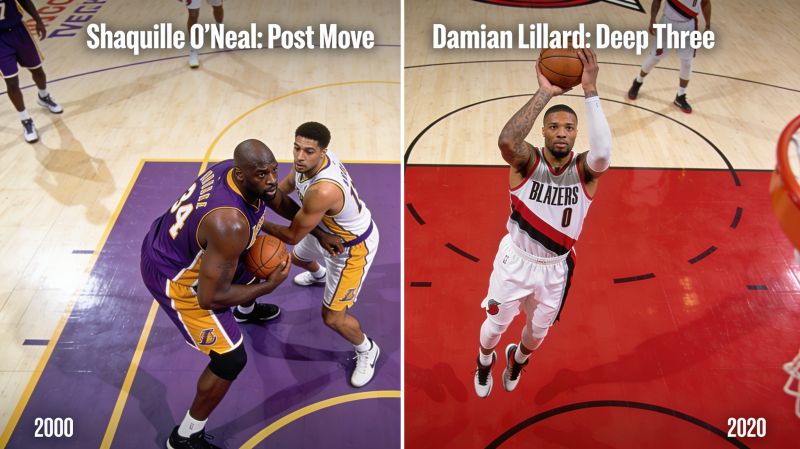
Maybe the real lesson from O'Neal and Lillard is about adaptability within a fixed identity. O'Neal never became a stretch five, but he added a refined post move and better free-throw mechanics late in his career. Lillard didn't suddenly become a lockdown defender, but he transformed his shot profile—more deep threes, more rim pressure。fewer mid-range floaters. Both understood that their core weapon was non-negotiable, but the delivery system could evolve. That's a blueprint for any player who wants to stay relevant across eras: pick your identity, then defend it with adjustments. O'Neal and Lillard did exactly that, and the NBA is still adjusting to both of them.